Choosing a Black Sidetable in 2026 requires more than matching a dark finish with a sofa. It involves scale, storage, materials, lighting, and daily use. The global furniture market continues to expand, with Grand View Research forecasting a 5.2% compound annual growth rate from 2023 to 2030. That growth brings more choices, but not necessarily better decisions. Some tables look elegant online and feel surprisingly unstable beside a real armchair.
The 2024 Houzz & Home Study also shows continuing investment in residential spaces, especially in functional upgrades and personalized interiors. A small sidetable can support that shift. Measure the seat height first. Leave enough clearance for a lamp cord. Check whether the black surface shows fingerprints, dust, or scratches under daylight. Matte powder-coated metal feels modern, while stained wood adds warmth. Neither option is universally superior.
Design authority Dieter Rams offered a useful principle: “Good design is as little design as possible.” His idea applies here, although a completely minimal table may lack practical storage. I sometimes prefer one drawer, even when it interrupts a clean silhouette. That is the uncomfortable trade-off. Before buying, compare the tabletop diameter, weight, edge profile, and return policy. Industry photographs cannot reveal wobble.
This guide examines those details. It also questions popular assumptions about black furniture, durability, and timeless style. Expect useful direction, not a perfect formula.
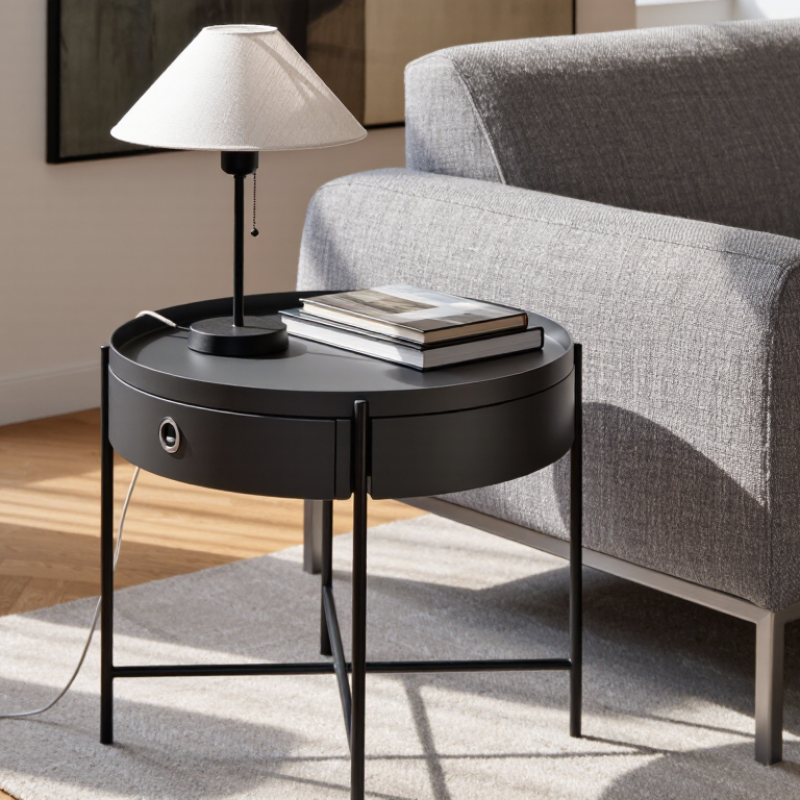
Choosing a black sidetable in 2026 should begin with measured space, not color. ANSI/BIFMA X5.5, the office desk-products standard, evaluates stability, strength, and durability. It does not prescribe one universal table height or clearance. That distinction matters. A table may pass performance testing yet still block a sofa, doorway, or knee space.
Measure the usable zone beside the chair. Leave about 2–4 inches between the tabletop and upholstery, avoiding awkward collisions. Keep walking routes visibly open. For an accessible layout, the ADA Standards specify 30 by 48 inches of clear floor space for a forward approach. This is not an X5.5 requirement, but it offers a useful planning reference. The U.S. Environmental Protection Agency reports that people spend approximately 90% of their time indoors, making daily reach, lighting, and movement practical design concerns.
I once chose a narrow black table by eye. It looked elegant, but its drawer struck the armrest. That shortcut was wrong. Check the product’s tested load, base stability, edge construction, and assembly instructions. Ask for documented conformity to ANSI/BIFMA X5.5 where applicable. Also inspect the actual footprint, including legs and handles. A 16-inch tabletop can become a 20-inch obstruction. Dark finishes reveal dust quickly, so a slightly textured, cleanable surface may perform better than a glossy one. Small details matter.
| Selection Dimension | Recommended Specification | Metric Equivalent | Why It Matters | ANSI/BIFMA X5.5 Consideration |
|---|---|---|---|---|
| Overall height beside a sofa | 22–26 in | 559–660 mm | Choose a top that is approximately level with the sofa seat or no more than about 2 in below it, making lamps, drinks, and devices easy to reach. | The standard evaluates table safety, strength, durability, and stability; it does not prescribe one universal end-table height. |
| Overall height beside a bed | 24–30 in | 610–762 mm | Match the tabletop to the top of the mattress or nearby bedside surface. Measure the actual bed height before purchasing. | Use the standard as a performance reference rather than as a dimensional design rule. |
| Compact width and depth | 16–20 in × 16–20 in | 406–508 mm × 406–508 mm | Suitable for narrow rooms, apartment seating, or a small reading corner while leaving more walking space. | Confirm that the selected model has adequate stability for its intended load and does not tip easily when a drawer or door is opened. |
| Balanced everyday size | 20–24 in × 20–24 in | 508–610 mm × 508–610 mm | Provides practical room for a lamp, book, phone, and drink without visually overpowering most sofas or lounge chairs. | A wider or deeper footprint generally improves resistance to tipping, but construction quality and center of gravity also matter. |
| Clearance from sofa or chair edge | 0–3 in | 0–76 mm | Keep the table close enough for comfortable reach while avoiding contact with armrests, upholstery, or reclining mechanisms. | Clearance is a room-planning recommendation, not a fixed ANSI/BIFMA X5.5 dimensional requirement. |
| Main walking clearance | At least 30 in | At least 762 mm | Allows a normal passage route around the table. Increase the space where people frequently carry objects or where accessibility is important. | The table standard does not replace building, accessibility, or local safety codes governing circulation space. |
| Clearance between table and wall | 2–4 in | 51–102 mm | Provides room for baseboards, cables, cleaning, and slight movement without making the table look disconnected from the wall. | Check the table’s stability and any anti-tip provisions when it is positioned near a wall or used with storage. |
| Clearance for a drawer or cabinet door | Door or drawer depth + 12 in | Door or drawer depth + 305 mm | Reserve enough forward space to open storage fully and stand comfortably without blocking the main route. | Operational clearance should be checked in the actual room; it is separate from the standard’s product-performance testing. |
| Top thickness | 0.75–1.25 in | 19–32 mm | Supports a substantial appearance and helps resist everyday flexing. Thicker tops can reduce usable knee or shelf clearance. | Thickness alone does not demonstrate compliance. Materials, joints, fasteners, and the complete structural design are also relevant. |
| Open shelf clearance | 10–14 in vertical | 254–356 mm | Accommodates common books, baskets, and small electronics while keeping the lower shelf useful and visually uncluttered. | Check that the shelf remains secure under its intended load and that the complete table remains stable during use. |
| Recommended everyday load planning | 15–30 lb on the top | 6.8–13.6 kg | Usually covers a lamp, books, drinkware, and personal electronics. Treat this as a conservative shopping target, not a certified capacity. | Use only the manufacturer’s stated capacity for the exact product. ANSI/BIFMA testing results should not be inferred from appearance or color. |
| Black finish and lighting | Matte or low-sheen surface | — | Matte black generally reduces glare and shows fewer reflections than a high-gloss finish. Dark surfaces can still reveal dust, fingerprints, and light scratches. | Finish color is not a performance classification under ANSI/BIFMA X5.5; inspect coating durability and cleaning instructions separately. |
| Standards verification | Request documented test information | — | Ask whether the complete table model was tested, which edition was used, and which configuration and load conditions were covered. | ANSI/BIFMA X5.5 is a voluntary performance standard for desk, table, and similar products. It addresses areas such as stability, strength, and durability rather than prescribing a specific size. |
| Measurement note: Always compare the table’s assembled dimensions with the room’s measured sofa, chair, bed, baseboards, outlets, doors, and walking paths. ANSI/BIFMA X5.5 performance information should be confirmed for the exact product and configuration. | ||||
Inspect the underside, drawer box, back panel, and unfinished edges. These areas may reveal particleboard, MDF, or hardwood plywood. Paint color proves nothing.
No. Odor is not a reliable safety test. Ask for compliance documents and panel details instead. Documentation matters more.
Applicable limits may include 0.09 ppm for particleboard and 0.11 ppm for MDF. Hardwood plywood may have a 0.05 ppm limit. Thin MDF may have a 0.13 ppm limit.
Request a compliance statement, certification details, and the product’s panel type. A vague “eco-friendly” claim is insufficient. Ask about the exact table.
Loose laminate can expose the panel core. It may weaken the furniture over time. Press the edges gently and check for lifting.
Place it on a flat surface and apply gentle side pressure. Check the frame, joints, fasteners, and floor-contact points. Adjustable feet help on uneven floors.
Ask for the exact model’s tested load rating and test scope. Confirm whether the rating is static or evenly distributed. Leave room for a laptop, lamp, water bottle, and accidental leaning.
Not necessarily. The report should cover the exact configuration you receive. Check the test date, drawers, casters, hardware, and included parts. “Tested” can be too broad.
Save screenshots, invoices, certificates, and written seller responses. Online listings may omit important panel information. My checklist is imperfect.
Choosing a Black Sidetable in 2026 requires more than matching its color to your room. Start by measuring the available space, walkway clearance, and intended use, then compare the table’s dimensions with applicable ANSI/BIFMA X5.5 guidelines for office and occasional tables. Evaluate the black finish through practical factors such as gloss level, scratch visibility, and coating adhesion, with ASTM D523 and ASTM D3359 test results offering useful points of comparison. A matte surface may hide fingerprints, while a higher-gloss finish can create a sharper, more reflective appearance.
For wood-based products, check whether materials comply with EPA TSCA Title VI formaldehyde limits, and review construction details that affect durability. Stability and load capacity should be supported by ANSI/BIFMA X5.5 testing or clearly stated performance data, especially if the table will hold lamps, books, or electronics. Finally, prioritize low-emission materials and products that meet UL GREENGUARD Gold criteria to help maintain better indoor air quality. Balancing size, finish, safety, strength, and emissions will lead to a more reliable purchase.

 Union Home